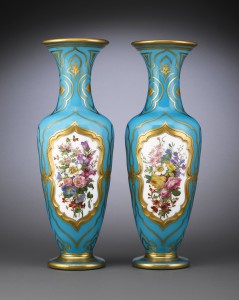

The beauty of Baccarat crystal takes so many forms. From dazzling crystal chandeliers to ornate ormolu and crystal centerpieces, the elegance of Baccarat design is recognized by museums, collectors, and royalty worldwide as some of the most desirable pieces of decorative art. These exceptional Baccarat vases are no exception. We are fortunate to have a pair of opaline glass vases from the Baccarat factory here at M.S. Rau. Possessing all the desired qualities of the very best opaline pieces – vibrant hues, lux gilding and ornate design – these vases are all the more exceptional because they are a complete pair. Cartouche “windows” are expertly hand-painted to house bouquets of delicate flowers. They are eye-catching, even in a gallery full of remarkable items like we have here.
Although some historians have argued that he was not a particularly effective king, Louis XV did bring France to a cultural high point during his reign. Thanks in part to his famed mistress, Madame de Pompadour, Louis XV patronized painters, cabinetmakers and sculptors, the ornate style of which now carries his namesake.
During Louis XV’s reign, the Baccarat glassworks company was founded in the town of Baccarat in the Lorraine region in eastern France. The year was 1734, and the company began producing stemware and mirrors for the wealthy European elite and royalty. After receiving its first royal commission in 1823, Baccarat was launched into worldwide demand, with designs that were beautifully ornate and uniquely French. Under the reign of Napoleon III, the use of opaline glass – an opaque and colorful decorative glass often accented with gilding – was introduced and became very popular. With a high lead content and jewel-like tones, the decorative pieces were meant to mimic Venetian glass, produced in Italy in the 16th century.
The peak of Baccarat’s opaline glass production was from 1850 – 1860, and these vases are dated to 1850. They are true masterworks of the Baccarat house and are vibrant pieces to behold. To learn more about these vases or M.S. Rau’s collection of Baccarat pieces, click here.


